CAD
CAD
 USD
USD
 EUR
EUR
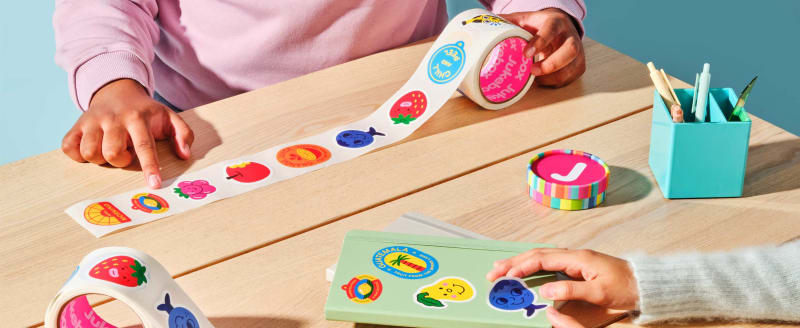

Here's a situation that comes up more often than you'd think. A candle brand orders die cut stickers for their jars. Or an illustrator getting ready for Adobe Max orders roll labels instead of die cut stickers for their conference table. Both cases, wrong product. The mix-up makes sense on the surface. But once you understand what each one is actually made from and what its designed to do, the right choice becomes pretty obvious.
Custom stickers are individual pieces of premium vinyl, cut to the exact shape of your design, built to last outdoors for years. Roll labels come wound on a roll, made from waterproof BOPP film or premium paper stocks, and are designed for product packaging, bottles, jars, and anything you're putting on a shelf or shipping to a customer. Same category. Completely different tools.
What are die cut stickers?
A die cut sticker is cut all the way through, through the vinyl layer and the backing paper, following the exact outline of your artwork. No rectangular border, no excess backing. Just your shape, clean and finished, ready to be peeled and applied to anything.
The material is premium vinyl with a protective laminate on top. That laminate does most of the work. It's what makes die cut stickers weatherproof, UV-resistant, and dishwasher safe. The vinyl itself is thicker and more rigid than any label film, which is the same reason a bumper sticker stays on a car for years without peeling or fading. Most finishes are rated for 3 to 5 years of outdoor exposure.
Because they're individual pieces, die cut stickers are easy to hand out, pack into orders, or use as packaging accents. They're standalone objects. A customer can grab one and put it on their laptop, water bottle, or skateboard, which is exactly the point.
Die cut vs. kiss cut, quickly: Die cut stickers are cut through both the vinyl and the backing paper, so each sticker arrives as an individual piece. Kiss cut stickers are cut through the vinyl only, leaving the backing sheet intact. Both are stickers. The difference is how they're delivered and how easy they are to peel.
What die cut stickers are best for
- Branded merch, giveaways, and promotional packs
- Laptops, water bottles, helmets, skateboards, and outdoor gear
- Packaging inserts and order accents
- Outdoor surfaces including bumpers, windows, vehicles, and equipment
- Any design that needs to look finished before it's even applied
Worth knowing: if you want multiple designs on a single sheet rather than individual pieces, sticker sheets are a third option. You get a full sheet with several different stickers printed together, great for sampling designs, creating sticker packs, or giving customers a curated set. Different format, same premium vinyl material.
What are roll labels?
Roll labels, also commonly called sticker rolls, are designed to be applied quickly, repeatedly, and consistently to products. They come wound on a roll, which makes them compatible with label applicators and dispensers. A business can label hundreds of units in the time it would take to hand-apply individual stickers.
The primary material is BOPP (biaxially oriented polypropylene), a thin flexible film that's waterproof, oil-resistant, and handles temperature extremes. It conforms to curved bottle surfaces and holds up to refrigeration, condensation, and everyday handling. For product labels, bottle labels, cosmetics, or wine labels, BOPP is typically the right call.
But roll labels also come in premium paper stocks, and this is something die cut stickers simply don't offer. Felt, vellum, kraft, hemp fiber, recycled paper, sugar cane pulp. These aren't just material choices, they're branding decisions. A candle label printed on Bright White Felt communicates something completely different than the same design on gloss BOPP. For product labels where the tactile quality of the packaging is part of the brand experience, paper stocks are often the better choice.
What roll labels are best for
- Product labels for retail, e-commerce, and wholesale
- Bottle labels for beverages, cosmetics, and personal care
- Candle labels and home fragrance products
- Food and beverage, including products requiring FDA-compliant labeling
- Wine, spirits, and specialty beverages
- Seal labels for bags, boxes, and mailers
What makes roll labels unique
People assume roll labels are just a utilitarian format. You need a label on a bottle, you order a roll. That's true, but it undersells what roll labels actually offer over every other sticker format.
Same custom shapes as die cut stickers. This surprises a lot of people. Roll labels aren't limited to rectangles and circles. You can get the exact same custom die cut shape on a roll label as you would on a vinyl sticker. The label for your hot sauce bottle can follow the curve of your illustration, the neck label on your wine bottle can be a bespoke silhouette, the seal on your mailer can be any shape you want. No setup fee. Same custom shape freedom, just delivered on a roll instead of as individual pieces.
Paper stocks that vinyl can't replicate. Roll labels are the only format where you can choose between BOPP film and genuine premium paper. Eggshell Felt, Bright White Felt, Hemp Vellum, Estate #8, Kraft, Recycled Vellum, Sugar Cane. These aren't coated stocks, they're real paper surfaces with texture and warmth that no vinyl finish can genuinely recreate. For brands in food, beverage, beauty, or home goods, this distinction alone is often the deciding factor. Explore the full range in our premium paper label stocks guide.
Built for scale without compromise. Whether you're applying labels by hand on a small run or running them through an industrial applicator at volume, the roll format is engineered for both. Product labels, bottle labels, and candle labels all ship on a standard roll core compatible with most dispensers. When your brand starts scaling, the format scales with you.
For product labeling, roll labels are the obvious choice
If you're putting a label on something you sell — a bottle, a jar, a coffee bag, a candle, a skincare product, a food container — roll labels aren't just a good option, they're the right one. This is exactly what they were designed for.
Think about what a product label actually needs to do. It needs to peel cleanly off a roll one after another without fumbling. It needs to conform to a curved surface like a bottle without lifting at the edges. It needs to stay put through shipping, refrigeration, handling, and condensation. And it needs to do all of that at a cost that makes sense when you're labeling hundreds or thousands of units. BOPP is engineered specifically for this. Nothing else comes close at that combination of performance and cost per label.
Die cut vinyl stickers can technically go on a bottle. And they'll look great. But the vinyl is thicker and stiffer than BOPP label film, which means it's harder to conform to tight curves and more likely to lift on narrow surfaces. The material is also significantly more expensive per unit — it's built to survive years on a car bumper or a water bottle someone carries hiking, not to be applied to 500 jam jars in an afternoon. Using die cut stickers for product packaging is like using a premium outdoor-rated material where a purpose-built label film does the job better for less.
The categories where this matters most:
- Bottle labels — beverages, spirits, water, sauces, dressings, kombucha
- Candle labels — glass jars, tins, any cylindrical container
- Coffee bags, spice pouches, and dry goods packaging
- Cosmetics, skincare, and personal care products
- Product labels for anything going to retail shelves or e-commerce fulfillment
- Food containers requiring FDA-compliant labeling
For all of these, roll labels are the cost-effective, purpose-built answer. Save the vinyl stickers for your merch table, your packaging inserts, and your branded giveaways — that's where they genuinely shine.
The material difference is the whole story
This is where most people's understanding shifts. It's not just about format, it's about what the material itself is engineered to do.
Vinyl stickers are thick by design. The heavier laminate is engineered to survive years outdoors including UV exposure, rain, dishwashers, and car washes. That thickness is also what gives die cut stickers their substantial, premium feel in your hand before you've even applied them.
BOPP label film is thin by design. It needs to peel cleanly off a roll, conform to curved bottle surfaces, and apply smoothly at speed. Thinner, more flexible material does all of that better. The trade-off is that it's not built for the same level of outdoor exposure as vinyl.
Paper label stocks are in a different category entirely. They're not about durability, they're about character. Running your fingers across Eggshell Felt or Hemp Vellum tells your customer something about your brand before they've even read the label. These stocks are exclusive to roll labels. You can't get them on a die cut sticker, and thats worth knowing before you decide. Read the full breakdown in our premium paper label stocks guide.
Durability: where they differ and why it matters
Die cut vinyl stickers are genuinely built for outdoor use. The Super Matte and Super Gloss finishes are rated up to 5 years outdoors. They're waterproof, dishwasher safe, and UV-resistant. The one exception is eco natural paper stickers, which are indoor only and designed for applications where vinyl isn't the right fit.
BOPP roll labels hold up well too, but in a different way. They're waterproof, oil-resistant, and temperature-stable, which is exactly what you need on a beverage bottle or a refrigerated product. What they're not rated for is years of UV exposure on a car bumper or outdoor equipment.
Paper roll labels are the most specialized case. Most paper stocks have wet strength, meaning they stay smooth and intact when refrigerated or exposed to humidity. But they're not waterproof and they're not meant for outdoor use. If your product gets wet regularly, BOPP is the right material. If your product sits on a shelf and the label is part of the brand experience, paper stocks are worth taking seriously.
Die cut stickers vs. roll labels vs. kiss cut stickers: full comparison
| Feature | Die Cut Stickers | Kiss Cut Stickers | Roll Labels (BOPP) | Roll Labels (Paper) |
|---|---|---|---|---|
| Material | Premium vinyl | Premium vinyl | BOPP film | Premium paper |
| Format | Individual pieces | Individual on backing sheet | Wound on a roll | Wound on a roll |
| Waterproof | Yes | Yes | Yes | No, wet strength only |
| Dishwasher safe | Yes | Yes | No | No |
| UV resistant | Yes | Yes | Limited | No |
| Outdoor lifespan | 3 to 5 years | 3 to 5 years | 2 to 4 years (permanent) | Not recommended |
| Temperature range | Wide range | Wide range | -40°F to +248°F | Dry or lightly chilled |
| Premium paper stocks | No | No | No | Yes, 8+ options |
| Machine applicable | No | No | Yes | Yes |
| FDA food contact | Food Safe finish only | Food Safe finish only | Yes | Yes |
| Best for | Merch, outdoor surfaces, giveaways | Sticker packs, retail display, fine detail designs | Bottles, jars, food and beverage | Candles, wine, artisan goods |
Finishes: specialty options vs. what works for packaging
Die cut stickers offer a wide range of specialty finishes. Holographic, brushed gold, brushed silver, rose gold, reflective, clear, spot gloss, textured matte, and more. When the sticker itself is the product, whether for merch, giveaways, or collector items, that range is a real advantage and the reason stickers are so popular with brands doing something visually expressive.
Roll labels keep finishes focused on what actually moves product. Gloss BOPP for vibrant shelf presence. Matte BOPP for a clean premium feel. Soft touch for a velvety surface that's hard to put down. Foiling and spot gloss for elevated, luxury packaging. These are the finishes that earn attention at retail.
Paper label stocks don't use a coating at all. The texture of the stock is the finish, and that's a deliberate design choice. It communicates craft and quality in a way that any glossy laminate would undermine entirely.
Kiss cut stickers are in their own league
Die cut and roll labels get most of the attention in this conversation, but there's a third format that deserves its own mention: kiss cut stickers. And roll labels simply can't do what kiss cut does.
A kiss cut sticker is cut through the vinyl only, leaving the backing sheet intact. The sticker sits on a clean rectangular or square backing that protects the design and makes peeling effortless. No individual loose pieces, no fumbling with edges. You peel it cleanly in one motion.
This makes kiss cut the preferred format for a few specific situations that neither die cut stickers nor roll labels handle as well. If you're creating a sticker pack with multiple designs, kiss cut lets each one live on its own backing with clean separation. If you're including stickers in a retail packaging context, the backing gives the sticker a polished, finished look before it's even been applied. If you're designing something with fine intricate detail or thin lines, the extra backing protects those edges during shipping and handling.
Roll labels can produce a label in any custom shape, but they arrive wound on a roll and aren't designed for individual distribution or retail display. A kiss cut sticker arrives ready to hand out, display in a shop, or slide into an envelope. That's a fundamentally different use case.
The quick reference: die cut for standalone individual pieces with no backing, kiss cut for individual pieces with a clean protective backing, roll labels for product packaging at any volume.
How creators, designers, and marketers use both
This is where it gets interesting. Most guides stop at product categories. But the people who get the most out of both products are the ones who use them together creatively.
Creators and independent designers almost always reach for die cut stickers first. They're the go-to for merch tables, event handouts, and order inserts. Handing someone a well-designed die cut sticker is one of the cheapest and most effective brand moments you can create. Customers stick them on laptops, water bottles, phone cases. Every time someone sees it, your brand travels further. Roll labels rarely make the cut here, because they're wound on a roll and not built for handing out one by one.
But roll labels open up a different creative lane. A designer launching their own product line can use a premium paper roll label on their tissue paper, sealed with a kraft or felt label instead of generic tape. That same label on the outside of a mailer box transforms unboxing into a brand moment. Bottle labels on promotional water bottles at events. Seal labels closing a branded paper bag. These aren't packaging afterthoughts, they're intentional design decisions that happen to use a format most creatives haven't fully explored yet.
Marketers tend to think in both channels at once. Die cut stickers go into swag bags, welcome kits, and influencer packages because they're tactile, personal, and shareable. Roll labels go on every physical product that ships, which means they're doing brand work at scale every single day. A cohesive brand uses the same design language across both, so the sticker someone gets at a pop-up and the label on the product they order online feel like they came from the same world.
The cleanest way to think about it: stickers go in people's hands. Roll labels go on your products. Both build the same brand, just at different moments in the customer experience.
Which one is right for your project
Most businesses eventually need both. A skincare brand uses BOPP roll labels on their bottles and die cut vinyl stickers as packaging inserts or wholesale collateral. A coffee roaster uses kraft paper roll labels on their bags and die cut stickers as a gift inside each order. They serve different surfaces and different moments in the customer experience.
But if you're choosing one to start, the use case makes the decision for you.
Choose die cut stickers when you need
- Merch, giveaways, or promo handouts
- Something to go on a laptop, car, or helmet
- Outdoor-rated durability, 3 to 5 years
- Dishwasher-safe material for drinkware
- Specialty finishes like holographic or metallic
- Low quantities starting at just 10
- A piece that looks finished before it's applied
Choose roll labels when you need
- Product labels for retail or e-commerce
- Bottle labels for beverages and cosmetics
- Candle labels and home fragrance
- High-volume application by hand or machine
- Premium paper stocks with real texture
- FDA-compliant adhesive for food products
- Consistent, repeatable application at scale
If you're still not sure, both products have sample packs. Ordering samples before you commit is one of the best moves you can make, especially for paper label stocks where the texture is half the decision and no photo does it justice. Explore custom sticker options or roll label options to get started.
Frequently asked questions
The biggest differences are material and format. Die cut stickers are made from premium vinyl and delivered as individual pieces, designed for surfaces like laptops, water bottles, and outdoor gear. Roll labels are made from BOPP film or premium paper and come wound on a roll for efficient application to product packaging. Same sticky backing, completely different jobs.
BOPP roll labels handle moisture, condensation, and temperature extremes well, but they're not designed for prolonged outdoor UV exposure the way vinyl stickers are. If you need something that survives on outdoor equipment, vehicles, or anything exposed to years of direct sunlight and weather, die cut vinyl stickers are the right choice, rated up to 5 years outdoors depending on the finish.
For most product packaging, yes. Roll labels peel cleanly off a roll, conform to curved surfaces like bottles and jars, and work with label applicators for high-volume runs. They also come in premium paper stocks like felt and vellum, and options like product labels and bottle labels that aren't available on stickers, which matters a lot for brands in categories like candles, cosmetics, and wine where texture communicates quality.
BOPP stands for biaxially oriented polypropylene, a thin plastic film stretched in two directions for strength and flexibility. It's waterproof, oil-resistant, and handles temperature ranges from -40°F to over 200°F. It's the standard material for product labels because it performs well across nearly every packaging category. Read the full BOPP labels guide for a deeper look.
Yes. Most vinyl die cut sticker finishes are dishwasher safe, which makes them a popular choice for branded drinkware and water bottles. The laminate layer protects against moisture and heat. Paper stickers are not dishwasher safe, and neither are most roll labels. If you need stickers that survive regular washing, vinyl die cut is the right material.
Jukebox roll labels come in a range of premium paper stocks that aren't available for stickers, including Bright White Felt, Eggshell Felt, Estate Vellum, Hemp Vellum, Kraft, Recycled Vellum, and Sugar Cane. Each has a different texture and character suited to specific product categories. Product labels and candle labels tend to work beautifully on felt and vellum, while kraft is a natural fit for dry goods and organic brands.