CAD
CAD
 USD
USD
 EUR
EUR

Allison Ellsworth was nine months pregnant when she flew to Los Angeles to pitch a drink she had been making in her kitchen.
It was 2018, and she and her husband Stephen had somehow talked their way onto Shark Tank. The product was called Mother Beverage, a mix of apple cider vinegar, fruit juice, and sparkling water that Allison had started making three years earlier because her gut health was suffering and nothing on the market tasted good enough to drink every day.
She had already taken it to a Dallas farmers market and caught the attention of a Whole Foods buyer. Now she was standing under studio lights, very pregnant, making her case to a panel of investors on national television.
Rohan Oza offered $400,000 for 25%. They took the deal and flew home.
Eighteen months later, everything they had planned for was gone.
The rebrand that launched a brand
After securing Shark Tank funding, Allison and Stephen killed the Mother Beverage brand.
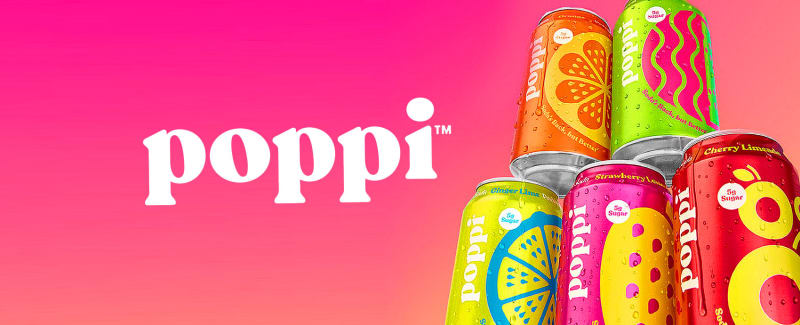
The boutique glass bottles with "mother" written in slanted cursive, the aesthetic that had charmed a Whole Foods buyer and impressed a panel of investors, all of it was replaced. What came out the other side was something completely different. Bright bi-colored cans, bold fruit imagery splashed across the side, and a name that rolled off the tongue.

Part of the decision was practical. They had never been able to trademark the name Mother, which meant retailers who wanted to stock the drink were being turned away. The rebrand wasn’t optional, but how Allison and Stephen handled it was.
They could have played it safe. Instead, working with Rohan Oza's CAVU Consumer Partners, they built a visual identity that was a direct rejection of the muted, earthy palette that dominated wellness branding at the time. Where competitors looked like they belonged in a yoga studio, Poppi looked like it belonged at a party.
The custom labels were saturated and loud, designed to be read in a second flat on a fridge shelf or a phone screen. The type was oversized. The copy was stripped back. Every element was calibrated to communicate the brand’s message in under a second.

The new Poppi cans… popped. And it was just as well, really, because the brand relaunched one week before the world went into lockdown. Terrible timing that, for a small brand still finding its footing in grocery stores, could have been the end.
Instead, it turned out to be the beginning.
In-store sampling was out of the question and retail foot traffic was all but decimated. But Allison and Stephen didn’t give up. Instead, they had their new screen-friendly branding to bring to the world.
It all started with a TikTok video
With the rebrand live and the retail world still shut, Allison turned to TikTok.
She posted a pared-back, very simple video of herself explaining the Shark Tank deal. It was calm and casual, and almost certainly wouldn’t have been signed off by a big brand’s marketing team (although maybe that’s a lesson in itself). But this is precisely why it worked.
The video reached 250 million views. In the 24 hours that followed, $100,000 in orders came through Amazon.
What happened next unfolded at break-neck speed over the next four years.
From small-time soda to Superbowl star (and some sticking points in between)
Poppi didn’t blow up on its own. During those lockdown years, so many brands relied on internet-native creators to speak up about their products. Poppi was no exception.
Except the brand didn’t have to incentivize influencers to influence. They were doing that already. The creators who started posting about Poppi soda were people who were already drinking it.
Alix Earle became an equity partner and a staunch Poppi ambassador.
Post Malone rocked up at festivals with a Poppi can in hand.
Jake Shane talked about it (and now stars in an ad). Leah Ketab talked about it. Everyone was talking about it.
The brand very quickly accumulated a very natural, very organic culture presence – a testament to the quality and purpose of the product. It also helped that the packaging was good-looking enough that people wanted to be seen with it.
Poppi cans almost became a cultural symbol in their own right. When a product is built to be looked at, everything about it, from the colors to the font pairings become content.
And then something even bigger happened.
The 2024 Super Bowl was Poppi's first major television buy. Around 100 million viewers tuned in, and search volume for the brand jumped 250% in the week that followed. A year later, the 2025 campaign starred Charli XCX in a spot called Make it Poppi, directed by Aidan Zamiri, the same director behind her A24 film.
Despite the household name fronting the campaign, the aesthetic stayed consistent throughout: saturated, energetic, built around the product and the people drinking it.
But not all brands can get it right every time. Especially such a new brand that blew up in a matter of years.
There was a moment in early 2025 where Poppi sent full-size branded vending machines to influencers in the build-up to Super Bowl LIX. The internet pushed back, calling it wasteful and out of touch. Poppi didn’t jump to defend itself. Instead, the brand acknowledged its oversight and engaged with the criticism. Within 24 hours, the backlash and Poppi’s mature response became yet another way for Poppi to get coverage.
The year before, a class action lawsuit claimed the two grams of inulin per can wasn’t sufficient to deliver genuine gut health benefits. The case settled for $8.9 million, and the brand kept going.
Poppi helped shaped the new era of soda
For most of the twentieth century, soda meant one of two things. You reached for a Coke or you reached for a Pepsi. The category hadn’t changed in decades, and the two companies that owned it liked it that way.
Then people stopped drinking it.
The decline was gradual at first, then persistent. Consumers were reading labels, cutting sugar, paying more attention to what they were actually putting into their bodies. The big soda companies responded with diet versions and zero-sugar lines, but people didn’t want less of the same thing. They wanted something different.
Poppi was that something different. A low-sugar sparkling drink built around apple cider vinegar and inulin, a plant-based fiber that feeds the good bacteria in your gut. It tasted like a soda, but it behaved like a wellness product. And crucially, it looked like neither.
The prebiotic soda category that Poppi helped build was worth around $480 million in 2024 and growing steadily, but the numbers miss an important point. What Poppi actually did was make gut health feel like something you could want rather than something you were supposed to do.
By the time Coca-Cola launched Simply Pop in early 2025 and PepsiCo announced its own Pepsi prebiotic soda line for later that year, the market had already been shaped. Both companies were following a trail that Allison had cut from her kitchen in Dallas. Olipop, the closest competitor, was valued at $1.85 billion in February 2025. Billion-dollar brands at the top of the chain were fighting over a category that barely had a name five years earlier.
In March 2025, PepsiCo announced it was buying Poppi.
The deal closed on May 19 for $1.95 billion. Allison has spoken about the decision: Poppi needed the kind of distribution infrastructure that takes decades to build, and PepsiCo already had it. But there’s another way to look at the acquisition. PepsiCo wasn’t simply buying a recipe. They were buying the proof that a generation of consumers would choose something built on personality and design and genuine belief over the thing their parents drank.
PepsiCo had been on a binge of buying brand-first companies when it came to purchase Poppi (Siete Foods, PopCorners, and Rockstar Energy, to name a few). They knew they were buying so much more than a “drink” (the brand had enough knowledge and resources to make its own prebiotic soda from scratch, and it did). What it was really buying was a brand position that even a centuries-old stalwart in the beverage space couldn’t manufacture.
What brands can learn from the “Poppi playbook”
By the time Poppi started finding its audience, the playbook for how to market a consumer brand was basically being rewritten in real time.
The old model was built around placement. You got your product onto shelves, you paid for the end-of-aisle display, you ran the in-store promotion. Brand awareness was bought through media spend and physical presence. It rewarded scale, which meant it rewarded whoever had been around the longest.
TikTok and a global pandemic changed that. Suddenly a founder with a phone and something to say could reach more people in a week than a mid-size brand could reach in a year of traditional advertising. The platforms were not just a new channel. They were a different game entirely, one where authenticity traveled fast and where the product itself, if it was interesting enough to look at, could become the content.

Poppi was built for that game. The cans were a direct expression of it. Bold color blocks, fruit imagery that popped against the bi-color background, type scaled up large enough to read on a small screen. When Allison or an influencer held a can up to camera, there was no need to include a logo in the corner or a caption underneath. The brand announced itself. The custom labels were doing the work that larger companies would have a big media budget for.
And then there was the creator strategy. What made this work was that Poppi didn’t treat it as advertising. The people who built the brand's early audience were not paid spokespeople reading from a brief. They were people who genuinely drank the product and enjoyed talking about it. That’s something much harder to do once a brand gets large enough to need sign-off on everything.
Alix Earle becoming an equity partner and an ambassador is the clearest expression of how seriously Poppi took this. It tied her incentives directly to the brand's success and it sent a signal to every other creator in her orbit: this is a brand worth betting on.
The visual identity held all of this together. Every piece of label printing on a Poppi can was consistent. Every color, every typeface, every can in every flavor stayed within the same bold, saturated system. The brand was instantly recognizable every time it appeared in the background of someone's video or got tagged in a post. That level of consistency is what allows a brand to travel across platforms and contexts without losing itself.
The fonts for branding choices Poppi made were not purely decorative decisions. They were functional ones, chosen to be legible at small sizes and carry the brand's energy all at once.
The Super Bowl campaigns were where the brand tested whether what had worked on a phone screen could hold up at the largest scale in advertising. It did.
4 key takeaways from Poppi’s rebrand

- The can did all the talking. Poppi’s cans were designed to work without a supporting campaign. If your product needs explanation before someone can want it, your packaging isn’t doing its job properly. Start with the choices you make about color, contrast, and what you leave out.
- They committed fully to the rebrand. When Allison and Stephen rebranded Mother Beverage to Poppi, they didn’t pick a safe middleground. They chose a name that sounded like nothing else in the category and matched it with a visual identity that couldn’t be confused on a shelf. This kind of commitment runs all the way through to the finish, the stock weight, the trim. Everything someone feels when they pick up the product for the first time.
- They weren’t afraid to go against the norm. The font pairing on Poppi’s cans doesn’t exist to purely look interesting. The graphic design trends Poppi leaned into during the rebrand, saturated color and maximal type were a deliberate move away from the minimal, neutral aesthetic dominating wellness at the time.
- They thought about every surface. The Poppi can was a marketing surface. So is everything else that carries your brand on it. When someone keeps your packaging, wears it, or slaps one of your custom stickers on their laptop, you’ve got yourself a placement that very few media budgets could buy.
10 years in the making
Allison has said she wouldn’t change a thing about her journey, because everything that’s happened has led her to where she is today. That’s not just the right thing to say after a $1.95 billion outcome. It’s a fair description of how brand building actually works.
You make a decision. You ship it. You figure out what works, and you do it all again. There was no master plan in that Dallas kitchen in 2015. There was just a drink that solved a real problem, a refresh that totally redesigned a 100-year-old soda industry, and a founder who was willing to show up on camera when no one else in her category was.
What held it together, across ten years and a pandemic and a lawsuit and two Super Bowl campaigns, was a visual identity that knew what it was and never hedged on it. The can looked the same on a grocery shelf in 2021 as it did in a Charli XCX campaign in 2025. That kind of consistency is what brand equity actually means in practice. It is not merely a logo. It’s everything a company keeps choosing, over and over again.