CAD
CAD
 USD
USD
 EUR
EUR


For the last five years, tech futurists have been writing the business card’s obituary. We were told the future was purely digital. We were told that LinkedIn QR codes or "bumping" phones would replace the handshake.
They were wrong.
New search data from Google Trends, combined with the rapid acceleration of orders on our own factory floor, shows that interest in business cards hasn't just recovered. In late 2025, it exploded to 5-year highs.
This isn't just speculation. As a global printing platform, we are the true source for this data because we are the ones fulfilling it. We produced millions of business cards in 2025, and we are currently seeing a rapid, synchronized rise in international volume that is keeping our machines running around the clock.
Here’s the data nobody else is talking about.
The Global Signal: A Breakout Year
Look at worldwide search volume for "business cards" over the last five years. It’s been a story of slow resilience until the end of 2025.
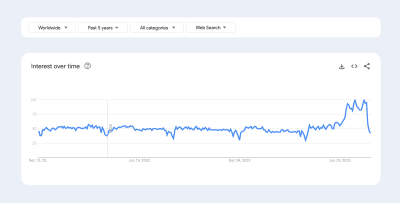
That sharp upward spike? That’s a "breakout". It smashed through the post-pandemic ceiling. It tracks perfectly with the Global Business Travel Association’s report, which forecasted business travel spending would hit a record $1.57 trillion in 2025.
As borders fully opened and international summits returned to full capacity in Q4, professionals realized that digital tools don't translate well across cultures. In a noisy global market, a tangible card is the universal language of "I am serious about this deal."
North America: The "Return to Office" Effect
In the US, the trend is steady. It mirrors the aggressive "Return to Office" mandates we've seen from the Fortune 500 this year.
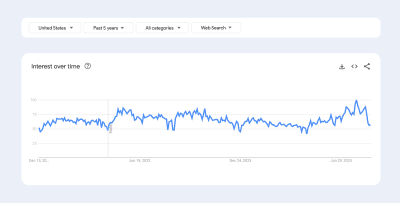
This steady climb correlates with the "RTO" enforcement waves at tech giants like Amazon. Amazon’s official policy now requires 5 days a week in the office, a mandate that kicked off a chain reaction across the industry. When employees are forced back into the office, they are also forced back into client meetings, networking lunches, and conferences.
In Canada, the story is even more aggressive. The data shows sharp volatility and a recent surge that eclipses anything we’ve seen in years.
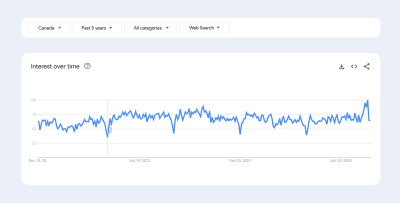
This is the "Sales Force Effect." Canadian businesses, particularly in the resource and tech sectors, are ramping up for a massive Q1 2026. The spike in late 2025 suggests teams are restocking for the January trade show circuit. You don't send a sales rep to hunt for revenue empty-handed.
The European Shock: Look at France
If you think this is just a North American thing, look at Europe. The data from France is, frankly, shocking.
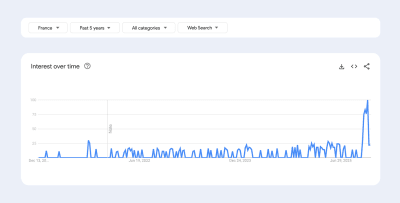
For years, interest in France was flat. Then, in late 2025, it went vertical.
The reason isn't a mystery. It’s the calendar. Paris just hosted a perfect storm of massive, face-to-face trade shows in early December that forced professionals to restock. SIMI, the massive corporate real estate summit (Dec 9–11), and Fi Europe (Dec 2–4) happened back-to-back.
These are "handshake industries." You can't taste a new food ingredient over Zoom, and you don't sell a commercial skyscraper with a QR code. The spike in France proves that when high-stakes, tangible industries meet in person, the digital business card fails. They went back to paper because they needed a tool that actually works.
Why Is This Happening Now?
Why are we rushing back to paper in the age of AI? It comes down to three things:
1. Digital Fatigue Your inbox is full. Your LinkedIn messages are spam. A digital contact is easily deleted. But a physical card is "sticky." It stays on a desk and takes up real space. Research has long shown that tactile marketing creates deeper emotional connections and brand recall than visual ads alone. In 2025, that matters.
2. Scarcity Creates Value When 90% of people offer a flimsy digital connection, the person who hands over a physical card stands out immediately. It signals effort. It signals preparation. The simple act of exchanging a card has become a mark of professionalism.
3. Smart Spending (What We're Seeing) 2025 was a standout year for us at Jukebox, but the type of orders changed. Customers aren't looking for "cheap"; they are looking for value.
We are seeing a massive shift toward durable, cost-effective stocks that look premium but don't break the budget. We have also seen a surge in demand for recycled and sustainable materials. Today's professional wants a card that feels substantial in the hand but aligns with their company's eco-values. They are rebranding their image to be smarter, sharper, and more sustainable.
The Takeaway
The charts and our global order volume don't lie. The world is moving outward again.
If you are heading into 2026 without a card that represents your brand, you aren't just saving money on paper. You are betting against the global economy. When you are ready to stand out, explore our collection of premium business cards and make sure your next handshake counts.