CAD
CAD
 USD
USD
 EUR
EUR
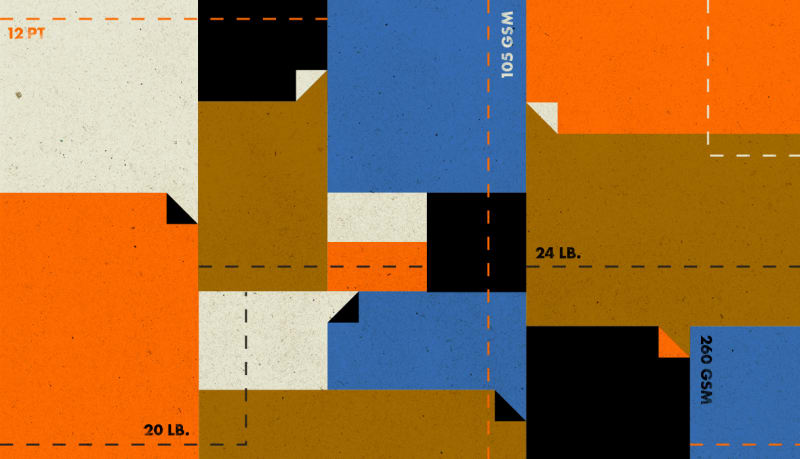

Whether you are an experienced designer or ordering for the first time, trying to stay on top of paper weights is a challenge for everyone. As one of the more confusing aspects of printed material, the 'weight' of paper or card stock can mean different things for different paper types.
From understanding print terms to confusing measurements, we help you get your head around paper weight in this blog post.
What is paper weight?
Paper weight is the weight of 500 sheets of paper (standard size) in its uncut state, which is measured in either Grams per Square Meter (GSM) or pounds. Paper weight can be confusing because different paper types have different standard sizes and weights. For example, text paper and cover paper are rarely the same size.
Generally speaking, a 75 GSM paper is considered lightweight, while 250 GSM-350 GSM is generally regarded as heavyweight card stock.
While paper weight is often weighed by the pound, this doesn't mean this number is what a retail package of paper will weigh. A ream of 20-pound Bond available at any office supply store does not actually weigh 20 pounds — its physical weight is probably around 5 pounds. Even though confusing, the paper weight is based on three key factors:
- The weight of 500 sheets of that paper in a specific size.
- The weight of a single sheet of that paper, in a specific size.
- The thickness of the paper in points is different from the points used to measure type, lines, and other things in layout.
Paper weight measured in pounds
Paper weight is typically measured in pounds (lbs), and the standard paper size is known as basis weight. This means that 500 sheets of the standard-size paper weigh a certain number of pounds. Basis weights are based on a material's specific gravity or density, so it can vary from one type to another.
Before we go any further, we hope we're not losing you. Trust us when we say, this stuff isn't simple. Almost everything about paper weights under the pound measurement system is antiquated, quirky, and comes from two centuries of very old-school processes and traditions, not all of which were meant to work together. Even though frustrating, understanding that makes it easier to grasp the whole system. Don't look for sense and order here, just some valuable facts.
The most common paper weight unit is pounds and usually comes in 20, 60, 70, and 100 pounds. Office printing commonly uses 20-pound Bond, your standard copier paper, while professional projects use slightly heavier, crisper, and more durable 24-pound paper.
Paper basis types & weights
Paper used to be manufactured to certain standards for specific uses, such as books, government forms, newspapers, and cards. It used to be differentiated by those end products, how a particular industry measured it, or specific use. Additionally, because of the many mills, machinery, and processes used to make paper in the 19th century (and even earlier), each paper type has a different raw or uncut size, known as the basis size. It is 500 sheets of this size that gives every kind of paper its basis weight —and the variation in basis size is why, say, a 60-pound Cover is much heavier than 80-pound Text.
The main reason to know these types today is because of the varying ways their weight is determined. This really is one of those cases where a pound of feathers does not weigh the same as a pound of iron! Understanding each type, weight, and size of paper is not essential, but knowing the specifics of paper commonly used today is what is. You will typically encounter four different paper weight types or classes:
- Bond is paper originally developed for government forms and bonds and is most commonly used for office-grade sheets for typing, inkjet, and laser printing. It uses the basis size of 22x17 inches; 500 sheets of 22x17 bond paper give its basis weight, usually 20 or 24 pounds. Bond is rarely seen past 32-pound weight.
- Book, Offset, and Text are essentially identical, and all use a basis size of 38x25 inches, or about 2.5 times larger than Bond. Thus, 500 sheets of these types can have a basis weight much higher than Bond and still be thinner, lighter paper.
- Cover is usually a heavier, stiffer paper stock, measured from a basis size of 26x20 inches. It's thus possible to have a lighter Cover stock that is thicker and stiffer than a heavier Text stock.
- Index is an alternate type of stiffer, heavier paper stock that uses one more basis size of 30.5x25.5 inches. Thus, a sheet of index stock would have about a 50% higher basis weight than Cover stock of about the same thickness.
Almost everything about paper weights is antiquated, quirky, and comes from two centuries of very old-school processes and traditions that don't necessarily work together.
Basis weight comparisons
Even though complicated, you must remember that Bond, Book-Offset-Text, Cover, and Index are measured on four different scales. Always note the paper type and weight when ordering or printing on a specific paper.
To use the chart below, read across the row. For example, you can see that a 20lb Bond is the exact same paper thickness as a 50lb Text, because they are both 75 GSM.
| Bond (Lbs) | Text / Offset | Cover (Lbs) | GSM (Standard) |
|---|---|---|---|
| 16 lb | 40 lb | — | 60 GSM |
| 20 lb | 50 lb | — | 75 GSM |
| 24 lb | 60 lb | — | 90 GSM |
| — | 70 lb | 40 lb | 105 GSM |
| — | 80 lb | 45 lb | 120 GSM |
| — | 100 lb | 54 lb | 150 GSM |
| — | — | 65 lb | 177 GSM |
| — | — | 80 lb | 218 GSM |
| — | — | 100 lb | 270 GSM |
| Card Stock | GSM | ||
| 12 PT | 260 GSM | ||
| 14 PT | 310 GSM | ||
| 16 PT | 350 GSM | ||
| 18 PT | 400 GSM | ||
| 20 PT | ~460 GSM | ||
| 24 PT | ~520 GSM | ||
| 26 PT | ~530 GSM | ||
Pounds are pretty basic to paper weight and printing, but let's put those other two measurements in context.
Paper weight measured in grams
The metric system method of specifying paper weight — widely used in Europe and Asia — is the simple and clearly understandable grams per square meter or GSM. One square meter weighs X grams, with, as an example, a 20 pound Bond being about 75 GSM. There is no adjustment of this value for the paper type, be it tissue, Bond, Text, or any other paper weight type. The actual thickness and finish of the stock might vary with the kind of paper, but the basis weight will not.
Pro tip: if you want an absolute reading on the paper's weight, look for a GSM value. GSM is usually noted somewhere in the package or catalog specs.
Paper weight measured in points
The third standard method of measuring paper weight is not by weight but has more to do with thickness. It is typically used for card stock where weight, per se, is not essential but stiffness and the 'feel' of thick material. This is a relatively straightforward measurement like GSM: 1 point (or 1pt) is one one-thousandth of an inch.
The most common weights for thicker card stock are 18pt, 20pt, and 24pt, often used for business cards, postcards, and other prints.
Choosing the right weight starts with the stock. See how each of our postcard stocks compares by thickness and finish.
The final measurement: caliper thickness
There is one more measurement of paper weight that is, on the one hand, so technical no designer will need to bother with it, but on the other hand, it can be so pragmatic designers can't ignore it. The actual measured thickness of paper, in thousandths of an inch, besides being the basis for points, is also called the caliper thickness or caliper.
For production, caliper is essential for adjusting press pressure. But for you, caliper is critical for one big reason: Direct Mail Regulations. Postal services will reject postcards that are too flimsy to pass through sorting machines.
Always be sure your printer knows a piece is for direct mailing so they can judge whether the finished article will meet all mailing standards. But for quick reference, if you stick to standard 14pt or 16pt cardstock, you will be safe mailing in almost any country.
If you want more creative inspiration next, explore our picks for graphic design trends for 2026, top illustrators to follow in 2026, and best free fonts.
Now... isn't that a weight off your mind?